
If you’ve ever stood in a cramped living space wondering where a sofa, a coffee table, and a place to actually walk are all supposed to fit, you’re not alone. Learning how to decor a small living room isn’t about squeezing in less it’s about making sharper choices so every square foot works harder. With the right layout, furniture, and storage strategy, even a 120-square-foot room can feel open, functional, and genuinely put-together. This guide covers the layout rules, furniture picks, and styling tricks that make the biggest visual difference, plus a few things most small-space guides skip entirely.
This guide breaks down how to decor small living room spaces step by step, from measuring and layout to furniture, storage, and styling.
Why a Small Living Room Needs a System, Not a Shopping List
Most people shop for furniture first and hope it fits later. That backfires fast in a small room, since there’s no spare space to absorb a mistake a sofa two inches too deep, or a rug a size too small, throws off the whole layout. The rooms that actually work are built in this order: assess the space, plan the layout, then choose furniture and decor that fit both. That sequence is really the whole answer to how to decor a small living room well it matters as much as any individual purchase.
Assess Your Space Before You Decorate
Measure First, Shop Second
Before buying anything, measure the room’s length, width, ceiling height, and the location of doors, windows, and outlets. Note fixed features a radiator, a chimney breast, built-in shelving since these dictate what’s possible before style enters the picture. Sketch it on paper or in a free floor-planning app. This ten-minute step prevents the most expensive small-space mistake: a piece that looks right in a showroom but overwhelms the room at home.
Identify Your Focal Point and the Room’s Main Job
Every well-decorated room is organized around one anchor a fireplace, a window view, a media wall, or a piece of art. Once you know what the eye should land on first, everything else (where the sofa faces, where lighting goes) becomes easier to decide. It also helps to name the room’s main job before styling it: a space built mainly for quiet lounging wants soft textures and one deep, comfortable seat, while a room that regularly hosts friends needs flexible seating and a clear path to move. Many small living rooms have to do both which is fine, as long as you know which one takes priority.
Small Living Room Furniture Arrangement That Improves Flow
Furniture arrangement is where most small living room decorating ideas succeed or fail, and it’s the part people rush past. The goal isn’t fitting more in it’s leaving enough clearance that the room doesn’t feel like an obstacle course.
A few working rules for small living room furniture arrangement:
- Keep at least 30 inches of clearance on main walkways and 14–18 inches between a sofa and coffee table.
- Anchor the room with your largest piece usually the sofa against the longest wall, then build outward.
- Don’t push every piece flush against the walls. Floating a sofa a few inches out, or angling a chair into a corner, often makes a room feel larger by adding a sense of depth instead of a flat perimeter.
- Square rooms suit an L-shaped or corner sectional; narrow rectangular rooms usually read better with a linear layout facing the focal point instead of furniture lined up along both long walls.
Small Condo Living Room Layout Tips
Condo living rooms usually add an extra wrinkle: the space bleeds into a dining nook or balcony with no wall to separate it. For a small condo living room layout, treat each zone as its own area. A rug under the seating area and a different rug (or bare floor) under the dining table gives each zone a visual boundary without adding furniture. Angling the sofa’s back toward the dining space is a simple way to signal “this is the living zone” without losing floor space.
Finally, walk the room the way you would on a normal day and let that path guide where furniture lands larger pieces belong on the perimeter, not in the middle of a high-traffic route. Of every layout decision, traffic flow has the biggest effect on how livable a small room actually feels.
Choosing Multifunctional Furniture for Small Living Rooms
A big part of how to decor small living room spaces on any budget is furniture selection. The best small living room furniture ideas are pieces that solve more than one problem. A storage ottoman is a footrest, extra seating, and hidden storage in one footprint. A lift-top coffee table becomes a laptop desk or dining surface in seconds. Nesting tables give multiple surfaces that tuck into one when they’re not needed.
| Furniture Type | Pros | Cons |
|---|---|---|
| Storage Ottoman | Doubles as seating, footrest, and hidden storage; easy to move | Limited weight capacity; not ideal as a permanent surface |
| Lift-Top Coffee Table | Adjusts to laptop or dining height; hides clutter inside | Hinge mechanism can look bulkier than a fixed table |
| Nesting Tables | Multiple surfaces from one footprint; easy to rearrange | Smaller individual surface; less sturdy for heavy items |
| Sofa Bed / Sleeper | Converts the room into a guest space instantly | Usually less comfortable than a dedicated sofa daily |
| Wall-Mounted Drop-Leaf Table | Folds flat against the wall when unused | Needs wall installation; limited seating when folded out |
Choosing two or three of these over a full matching furniture set almost always leaves more usable floor space than trying to furnish “completely” with single-purpose pieces.
Small Living Room Storage and Seating Ideas
Storage is where the “how to decor a small living room” question gets hardest to answer, and where small rooms quietly fall apart. A room can be laid out perfectly and still feel chaotic if there’s nowhere to put remotes, chargers, or the mail. Two strategies do most of the work: hiding storage inside furniture you already need, and moving storage vertically instead of eating floor space.
How to Style Shelves in a Small Living Room
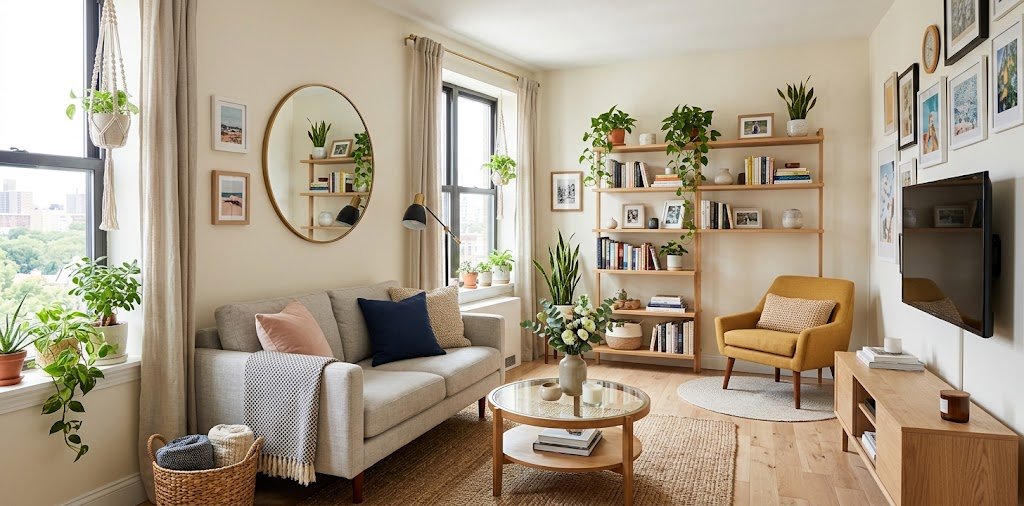
Poorly styled open shelving can make a small room look busier instead of better. A simple rule stylists rely on is the “zigzag” approach: alternate tall and short objects across each shelf instead of lining everything up at the same height, and group items in odd numbers rather than pairs. Leave roughly a quarter of each shelf empty negative space reads as intentional, while a fully packed shelf reads as clutter.
Vertical Storage to Save Floor Space
When floor space runs out, walls become the next resource. Floating shelves, a tall narrow bookcase in an unused corner, or a wall-mounted cabinet above eye level for off-season items all add real storage without shrinking usable floor. This is one of the more overlooked small living room storage and seating ideas most people think “storage” means another cabinet rather than using height that’s already free.
How to Decorate a Small Living Room for Entertaining
Knowing how to decorate a small living room for entertaining without sacrificing everyday comfort comes down to flexible seating rather than permanent extra chairs. A pair of lightweight poufs, or a bench tucked under a console table, can come out only when guests arrive. Choose seating light enough to move solo a leggy accent chair, a stackable stool and keep a clear path from seating to the kitchen or door, since congestion is what actually makes small-room entertaining feel stressful.
For small living room ideas for lounging and entertaining to share the same space well, give the room one clear “default” mode usually lounging with a fast way to shift into hosting mode: a coffee table light enough to slide aside, or a console that already hides extra seating beneath it.
Color, Light, and Mirrors: Making the Room Feel Bigger
Color and light change how spacious a small living room feels more than almost any furniture decision. Light, neutral tones soft white, warm beige, pale gray reflect more light and reduce visual breaks between walls, floor, and furniture, and keeping the wall and ceiling color close in tone helps the ceiling read as taller. A single overhead fixture leaves shadowy corners that shrink a room, while layering ambient, task, and accent lighting spreads illumination evenly across the space. A large mirror opposite a window is one of the few genuinely free upgrades in small space interior design it bounces daylight back and visually doubles the sense of depth near that wall.
How to Make a Small Living Room Feel Less Cluttered
Clutter is rarely about having too much stuff it’s usually too many small, competing objects with no clear “home.” A few habits fix this fast:
- Limit surfaces to a few larger objects rather than many small ones one substantial vase reads calmer than five tiny trinkets.
- Give everyday items a designated spot a tray for remotes, a basket for throws so they have somewhere to land besides the coffee table.
- Edit before you decorate. Remove anything that doesn’t serve the room’s main function before adding anything new.
- Keep window treatments light. Heavy curtains that block window light make an already-small room read even smaller.
Small Living Room Measurement Cheat Sheet
| Element | Recommended Clearance |
|---|---|
| Main walkway / traffic path | 30–36 inches |
| Sofa to coffee table | 14–18 inches |
| Coffee table to TV/focal wall | 3–4 feet, adjusted to screen size |
| Chair spacing for conversation | Within 8 feet of the sofa |
| Rug under furniture | At least the front legs of the sofa and chairs on the rug |
Small Living Room Design Styles That Hold Up at Any Size
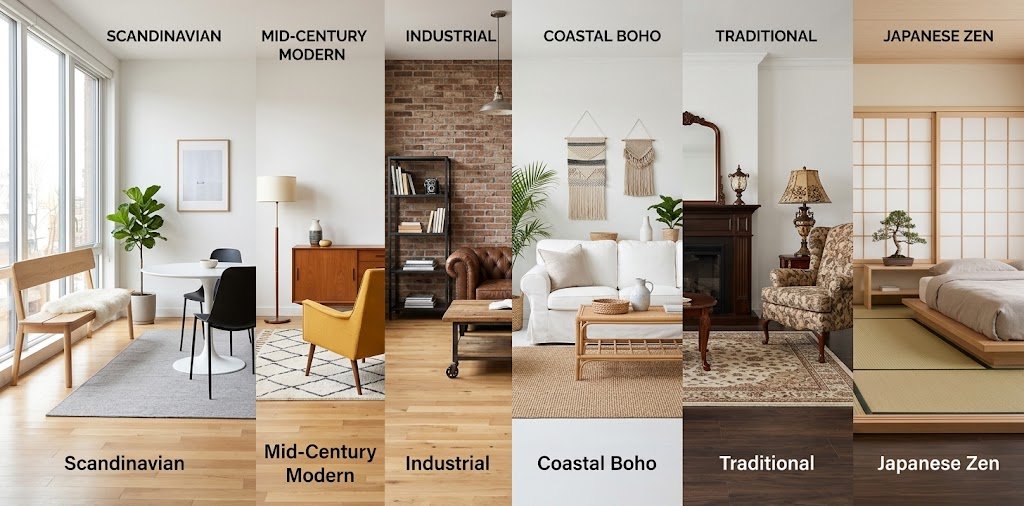
Not every design style suits a compact footprint equally well heavily layered maximalist looks tend to fight a small room instead of working with it. Scandinavian-inspired minimalism (light wood, a neutral palette, a small furniture count) and Japandi (the same restraint, paired with warmer materials like linen and rattan) both hold up consistently, since restraint is already built into the look. Repeating two or three materials and one color story throughout reads as considered; mixing five unrelated styles reads as unplanned, however nice each piece is on its own.
Common Mistakes to Avoid When Decorating a Small Living Room
Even a well-planned room can fall short from a few easy-to-repeat mistakes: a sofa too deep for the room’s proportions, pushing every piece against the wall out of habit, a rug that only fits under the coffee table, and too many small decorative objects instead of a few well-chosen larger ones. None of these are about taste they’re habits that work fine in a bigger room and simply don’t translate to how to decor a small living room the right way.
FAQs
What is the best way to decor a small living room?
The best approach to how to decor a small living room starts with an accurate floor plan, anchors the layout around one focal point, chooses furniture with a lighter visual footprint (raised legs, slim arms), and keeps the color palette to two or three tones.
How do I make my small living room look bigger without renovating?
Use light, neutral colors, add one large mirror opposite a window, hang curtains higher and wider than the window frame, and choose furniture with visible legs instead of skirted bases.
What furniture should I avoid in a small living room?
Avoid oversized sectionals, bulky skirted sofas, coffee tables that block walkways, and full matching furniture sets that fill the room with single-purpose pieces.
How can I fit a dining area into a small living room?
Choose a round or drop-leaf table against a wall or near a window rather than centered in the room, and use armless chairs or a slim bench to save space around it.
How many pieces of furniture should a small living room have?
Stick to essentials a sofa, one or two chairs, a coffee table, and a single storage piece. Add more only if each item serves a clear, distinct purpose.
Conclusion
A small living room doesn’t need more space to work it needs a clearer plan. Measuring first, building the layout around one focal point, choosing multifunctional furniture, and using color, light, and smart storage with intention will do more for the room than any amount of extra decor. That, in short, is how to decor a small living room that holds up day to day, not just in photos. Whether the goal is a quiet spot to unwind or a space that can host friends on a Friday night, the same approach applies: plan the function first, then let the styling follow.